Bitcoin dominance is a simple idea that helps us understand the cryptocurrency market. It measures Bitcoin's share of the entire crypto market, giving a sense of how much attention and value is focused on Bitcoin compared to other digital currencies.
Disclaimer: This article is for informational purposes only and does not constitute financial advice. Always conduct your own research before making any financial decision.
What Is Bitcoin Dominance?
Bitcoin dominance is a metric that tells us the percentage of the total crypto market cap that belongs to Bitcoin. Think of the entire cryptocurrency market as a big pie. Bitcoin dominance shows what slice of that pie is Bitcoin's.
Total crypto market cap: This is the combined total value of all cryptocurrencies that exist. To find the value of any single cryptocurrency, you would multiply its current price by the number of coins currently available to the public.
Bitcoin's dominance can change, rising and falling much like the tide. These movements are often influenced by overall feelings and behaviors within the market.

How Does Bitcoin Dominance Work?
To calculate Bitcoin dominance, we take Bitcoin's market capitalization and divide it by the total market capitalization of all cryptocurrencies combined. Let's break down those terms:
Market capitalization: The total value of all the coins of a particular cryptocurrency currently in existence. It's found by multiplying the current price of one coin by the total number of coins available to the public. Circulating supply: The specific number of coins or tokens that are publicly available and actively being used in the market.
Historically, when Bitcoin first launched in 2009, it was almost the only cryptocurrency available. This meant its dominance was extremely high, often holding between 95% and 99% until early 2017.
However, things began to change when new cryptocurrencies, known as altcoins, started to emerge. Altcoins are simply any cryptocurrency other than Bitcoin. As more people became interested in these new digital currencies, money began to flow from Bitcoin into them.
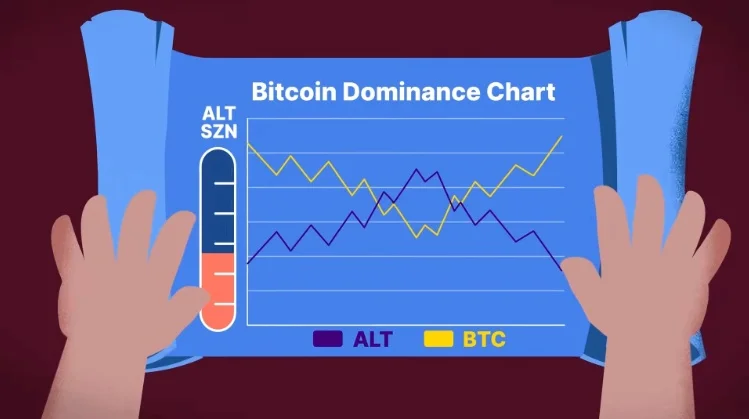
This led to periods where altcoins performed very well, a time often called alt season. During an alt season, altcoins tend to gain value faster than Bitcoin, which causes Bitcoin's dominance to decline. For example, by early 2018, Bitcoin's dominance dropped to about 35%.
When overall market confidence is high and people feel optimistic, they often move money from Bitcoin into smaller, potentially riskier altcoins. This action pushes Bitcoin's dominance down.
Conversely, when the market becomes uncertain or people feel cautious, they often move their funds back into Bitcoin. Many view Bitcoin as a more established and 'safer' choice during difficult market times, which drives its dominance back up. This back and forth movement between Bitcoin and altcoins is a key part of understanding market cycles.


Why Does Bitcoin Dominance Matter?
Bitcoin dominance offers a helpful perspective for understanding how money moves within the cryptocurrency market. It's like a lens that shows us where the focus of activity and value lies.
It helps us distinguish between different market phases. For instance, if Bitcoin's price is rising and its dominance is also rising, it often means Bitcoin is leading the overall market rally. This is a common pattern at the beginning of a market upswing.
However, if Bitcoin's price is still climbing but its dominance begins to fall, this can signal an alt season. This means altcoins are starting to gain value at a faster rate than Bitcoin, indicating a shift in market focus.
Conversely, if Bitcoin's price is falling but its dominance is rising, it often suggests that altcoins are experiencing even larger drops in value. This can happen during market downturns, as people tend to move money out of riskier altcoins and back into Bitcoin, causing Bitcoin's share of the market to increase relative to the rest.
Understanding these patterns helps people get a clearer picture of overall market sentiment and where value is flowing. Some individuals use the Bitcoin dominance chart to help them gauge the likelihood of an alt season occurring.
Key Terms You Should Know
Term | Plain-English Meaning |
|---|---|
Bitcoin dominance | A metric measuring Bitcoin's percentage of the total cryptocurrency market's value. |
Market capitalization | The total value of all existing coins of a specific cryptocurrency, calculated by price multiplied by circulating supply. |
Total crypto market cap | The combined market capitalization of all cryptocurrencies in existence. |
Circulating supply | The number of cryptocurrency coins or tokens currently available and actively in use by the public. |
Altcoins | Any cryptocurrency other than Bitcoin. |
Alt season | A period when altcoins increase in value faster than Bitcoin, often leading to a decrease in Bitcoin's dominance. |
Stablecoins | Digital currencies designed to hold a stable value, often pegged to a real-world asset like the US dollar. |
Common Misconceptions
- Bitcoin dominance is a perfect and flawless metric.Correction: While useful, Bitcoin dominance does not account for cryptocurrencies that are permanently lost. It also doesn't fully reflect the role of stablecoins, which are digital currencies designed to maintain a stable value and are often used as a safe haven during market downturns.
- The exact dominance number is always the most important factor.Correction: The precise number can be affected by factors like lost coins. However, the bigger picture – how Bitcoin and altcoins move in relation to each other and the overall trend of dominance – is often a more reliable signal for understanding market dynamics.
Frequently Asked Questions
Is Bitcoin dominance always accurate?
Bitcoin dominance is a very useful indicator, but it's not absolutely perfect. It provides a strong overview of market trends but does not factor in things like permanently lost coins or the significant role of stablecoins in the market. These elements can slightly alter the exact percentage, but the overall trend usually remains reliable.
Do I need Bitcoin dominance to buy cryptocurrencies?
No, you do not need to understand or use Bitcoin dominance to buy cryptocurrencies. It is an analytical tool that some people use to understand market patterns and sentiment. You can participate in the crypto market without tracking this metric.
How does Bitcoin dominance relate to market trends?
Bitcoin dominance often reflects the overall mood of the cryptocurrency market. When people are feeling cautious, dominance tends to rise as funds move into Bitcoin. When there's more optimism and a willingness to take on more risk, dominance tends to fall as funds shift towards altcoins. It helps show which part of the market is currently leading or lagging.
Can I track Bitcoin dominance myself?
Yes, you can easily track Bitcoin dominance. Many cryptocurrency data websites and charting platforms openly display the Bitcoin dominance chart. It's a publicly available metric that anyone interested in market analysis can access.