Ethereum is a decentralised blockchain platform that stands as the world's second-largest cryptocurrency by market capitalisation. Launched in 2015 by Vitalik Buterin, it pioneered programmable smart contracts that enable a vast ecosystem of decentralized applications (dApps), DeFi protocols, and NFT ecosystems. In 2022, Ethereum underwent a significant transformation, transitioning from a Proof of Work (PoW) to a Proof of Stake (PoS) consensus mechanism through an upgrade known as The Merge, which substantially improved its energy efficiency.
Disclaimer: This article is for informational purposes only and does not constitute financial advice. Always conduct your own research before making any financial decision.
What Is Ethereum?
Ethereum is a foundational blockchain platform renowned for its ability to host smart contracts, which are self-executing agreements with the terms directly written into code. This capability allows developers to build and deploy a wide array of applications, distinguishing it from earlier blockchains. It underpins decentralized finance (DeFi), enabling peer-to-peer lending, trading, and insurance without intermediaries, and powers the burgeoning market for Non-Fungible Tokens (NFTs).
How Ethereum Works
Ethereum's operation relies on its Proof of Stake (PoS) consensus mechanism, a significant shift from its initial Proof of Work (PoW) model. This transition, completed in 2022 with The Merge upgrade, means that instead of miners competing to solve complex puzzles, validators are chosen to create new blocks based on the amount of ETH they have 'staked' as collateral. This makes the network more energy-efficient and scalable.
Recent and upcoming upgrades further enhance Ethereum's functionality and efficiency:
- The Pectra upgrade in May 2025 introduced 11 Ethereum Improvement Proposals (EIPs), focusing on improving smart wallet capabilities, staking mechanisms, and the efficiency of rollups (Layer 2 scaling solutions).
- The Fusaka upgrade implemented PeerDAS to optimize data availability and reduce costs for network nodes.
- The Glamsterdam upgrade, scheduled for the first half of 2026, will introduce EPBS (enshrined proposer builder separation), aiming to enhance the network's decentralization and censorship resistance. It also targets increasing transaction throughput to 10,000 transactions per second.
- The Hagota upgrade, planned for late 2026, will incorporate veral trees. These are designed to make running a node significantly lighter and address the state bloat problem, where the blockchain's size and processing requirements grow over time, potentially slowing down the network.
Proof of Stake (PoS): A consensus mechanism where participants (validators) lock up cryptocurrency (stake) to get a chance to validate new transactions and add them to the blockchain. This replaces energy-intensive mining.
The Merge: A significant Ethereum upgrade in 2022 that transitioned the network's consensus mechanism from Proof of Work to Proof of Stake.
EIPs: Ethereum Improvement Proposals are standards that specify new features, processes, or changes to the Ethereum platform.
Rollups: Layer 2 scaling solutions that execute transactions off the main Ethereum blockchain (Layer 1) and then post compressed transaction data back to Layer 1, improving throughput and reducing fees.
PeerDAS: A technology focused on optimizing the way data is made available across the network, reducing the resources needed for nodes to operate.
EPBS (enshrined proposer builder separation): A proposed mechanism to further decentralize block production by separating the roles of proposing and building blocks, enhancing network resilience.
Veral trees: A technical solution aimed at reducing the data storage and processing requirements for running an Ethereum node, making the network lighter and more efficient.
State bloat: The problem of a blockchain's increasing size over time, which can make it more challenging and costly to run a full node.
Use Cases
Ethereum's versatile smart contract platform facilitates a broad spectrum of applications:
- Decentralized Applications (dApps): A vast ecosystem of applications ranging from gaming to social media operates on Ethereum.
- Decentralized Finance (DeFi): Ethereum is the backbone for numerous DeFi protocols, enabling lending, borrowing, decentralized exchanges, and asset management without traditional financial intermediaries.
- NFT Ecosystems: The majority of non-fungible tokens are issued and traded on the Ethereum blockchain, forming a significant digital art and collectibles market.
- Stablecoins: Ethereum serves as the primary settlement layer for a substantial portion of the global stablecoin market, holding approximately 70% of the entire supply, valued at around $170 billion.
- Tokenized Assets: Large financial institutions, such as BlackRock, are leveraging Ethereum for the tokenization of real-world assets, including US treasuries, with over $2.4 billion in assets existing on the network.
Tokenomics
Ethereum's tokenomics involve mechanisms designed to manage its supply and incentivize network participation.
Feature | Description |
|---|---|
EIP-1559 (Burn Mechanism) | This mechanism removes a portion of transaction fees from circulation, aiming to make ETH a deflationary asset. However, due to significant reductions in network fees (a 98% drop from $30 million to $500,000 daily revenue), the burn mechanism's impact has lessened, leading to a period where Ethereum has become inflationary again. |
Staking Yield | Users can stake their ETH to support network security and earn rewards, typically ranging between 3% and 4% annually. This yield provides an incentive for holders to lock up their assets and participate in the Proof of Stake consensus. |
Supply Status | Currently, Ethereum's supply is experiencing inflationary pressure due to reduced fee burn as Layer 2 solutions capture more transaction activity. However, if a staked Ethereum ETF is approved, it could introduce new demand and change the economic dynamics, as holding such an ETF would offer a yield comparable to direct staking. |
Ecosystem & Ecosystem Projects
The Ethereum ecosystem is vast, comprising a mainnet and various Layer 2 scaling solutions and projects that build upon its foundation.
- Base: A Layer 2 network developed by Coinbase, which settles its transactions on the Ethereum mainnet. In 2025, Base generated over $94 million in profit.
- Arbitrum: Another prominent Layer 2 solution designed to scale Ethereum by processing transactions off-chain and then recording them on the mainnet.
- Decentralized Applications (dApps): Thousands of dApps across various categories like gaming, social media, and productivity tools run on Ethereum.
- Decentralized Finance (DeFi) Protocols: The majority of DeFi projects, including lending platforms, decentralized exchanges (DEXs), and yield aggregators, are built on Ethereum.
- NFT Marketplaces: Platforms for buying, selling, and creating NFTs extensively utilize Ethereum's smart contract capabilities.
Risks and Considerations
Ethereum, like any complex technological and financial system, presents several risks and considerations for participants:
- Revenue Decline: The Ethereum mainnet has experienced a significant drop in daily fee revenue, with a 98% decrease from $30 million to approximately $500,000. This impacts the effectiveness of the EIP-1559 burn mechanism and can lead to inflationary pressure.
- Layer 2 Competition and Value Capture: While Layer 2 solutions enhance scalability, some critics argue they may divert value and revenue away from the Ethereum mainnet, with L2s capturing execution value and Ethereum serving primarily as a low-revenue settlement layer.
- Regulatory Environment: Regulatory uncertainty, particularly in the US, has impacted the functionality of spot Ethereum ETFs. The inability for US spot ETFs to offer staking yield creates a significant opportunity cost for institutional investors compared to direct ETH holdings, leading to lower ETF inflows and substantial outflows from older trusts like Grayscale.
- Institutional Outflows: The Grayscale Ethereum Trust (ETHE) experienced over $5 billion in outflows after spot ETFs were approved, creating consistent sell pressure that new ETF inflows struggled to absorb.
- Corporate Treasury Sell-offs: The trend of digital asset treasury companies (DATs) acquiring ETH led to a vicious cycle. As the price dropped, some DATs were forced to sell ETH to fund share buybacks, further contributing to price declines.
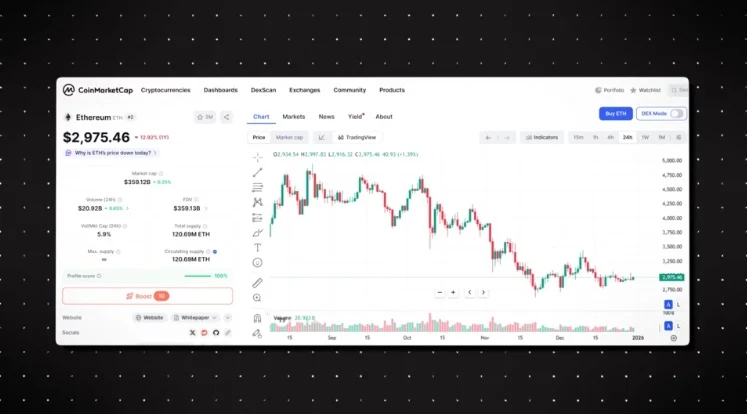
- Market Sentiment and Price Action: Ethereum has faced periods of lagging price action and negative market sentiment, exacerbated by factors like disappointing ETF flows and narratives suggesting Layer 2s are detracting from the mainnet.
Frequently Asked Questions
Is Ethereum a good investment?
This article is for informational purposes only and does not constitute financial advice. Individuals should conduct their own thorough research and consider their financial situation before making any decisions.
How does Ethereum differ from Bitcoin?
Ethereum differentiates itself from Bitcoin primarily through its focus on smart contracts and decentralized applications (dApps). While Bitcoin is largely known as a digital store of value and peer-to-peer electronic cash, Ethereum provides a platform for developers to build a wide range of programmable applications and ecosystems.
What is Ethereum used for?
Ethereum is used for hosting smart contracts, powering decentralized applications (dApps), DeFi protocols, and NFT ecosystems. It also serves as a critical settlement layer for a significant portion of the stablecoin market and for tokenized assets, such as tokenized US treasuries.
Is Ethereum safe?
While Ethereum's network security is a core focus, all cryptocurrency investments carry inherent risks including market volatility, regulatory changes, and technical vulnerabilities. Users should understand these risks and conduct their own research.
What are Layer 2 solutions on Ethereum?
Layer 2 (L2) solutions are scaling technologies built on top of the Ethereum mainnet to improve transaction speed and reduce fees. Projects like Base and Arbitrum are examples of L2 networks that process transactions off-chain and then settle them securely on Ethereum's Layer 1.
How did Ethereum's consensus mechanism change?
Ethereum transitioned from a Proof of Work (PoW) consensus mechanism to Proof of Stake (PoS) in 2022 with an upgrade known as The Merge. This change was designed to make the network more energy efficient and enhance its security and scalability over time.