What Is Solana?
Solana is a high-speed digital network designed to process many online transactions very quickly and cheaply. It is a type of blockchain, which is like a shared digital record book that keeps track of all transactions across many computers. Solana aims to make sending digital information as fast and affordable as possible.
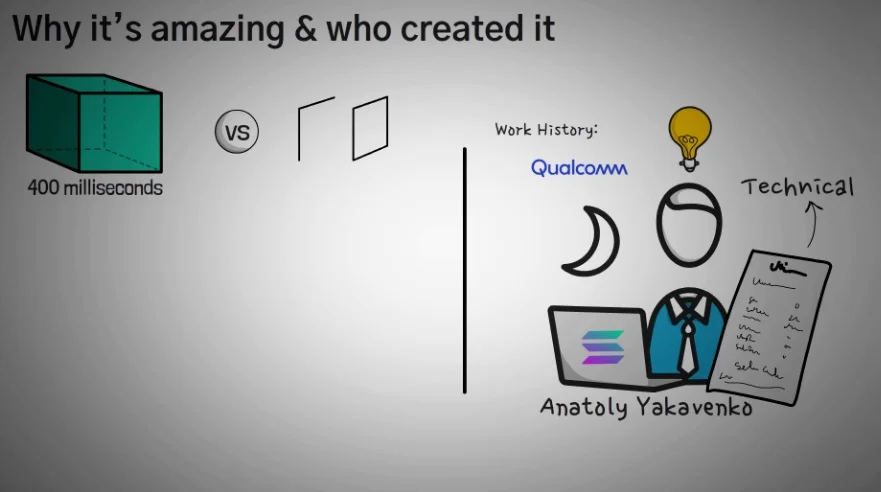
This network was created in 2017 by Anatoly Yakovenko. It focuses on speed and efficiency to allow for a wide range of digital activities.
Disclaimer: This article is for informational purposes only and does not constitute financial advice. Always conduct your own research before making any financial decision.
How Does Solana Work?
Solana uses several unique technologies to achieve its high speeds. One key part is how it agrees on the order of events, using a method called Proof of History (PoH). This works alongside its main way of confirming transactions, known as Proof of Stake.
blockchain: A shared digital record book that securely stores information across many computers. Proof of History: A way to include time in the digital record book using timestamps, helping computers agree on the order of events without constant communication. Proof of Stake: A method where participants can confirm transactions and add new records by temporarily locking up their digital assets.
Proof of History helps the network's computers, called validators, agree on the sequence of events very quickly. Instead of constantly talking to each other to figure out the exact time a transaction happened, PoH uses cryptographic timestamps.
validators: Special computers on the network that confirm transactions and add new records to the blockchain. timestamps: A specific date and time digitally attached to a piece of data.
Think of it like a family sending letters, and you want them to arrive in order. If everyone agrees to send their letter at a specific time on specific days (like Uncle on Jan 3rd, Aunt on Jan 4th), you can sort them by the time they wrote it once they arrive, even if they arrive out of order. Solana's validators use these timestamps to know the correct order of records without needing to constantly check with each other beforehand.
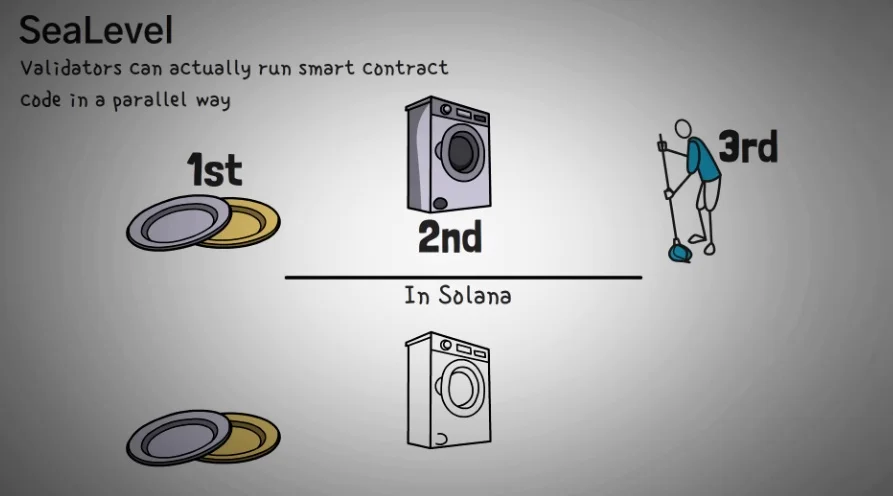
Solana also features something called SeaLevel. This allows its validators to work on many tasks at the same time, which is known as parallel processing.
SeaLevel: A technical feature that enables validators to process multiple tasks simultaneously. parallel processing: Performing several tasks at the same time, rather than one after another. smart contract: A self-executing program stored on a blockchain that automatically runs when specific conditions are met.
Most other networks handle tasks one by one, like a person doing dishes, then laundry, then sweeping – called sequential processing. SeaLevel is like having multiple copies of yourself to do all those chores at once, making the network much faster.
sequential processing: Performing tasks one after the other in a strict order.
The programs that run on Solana, called smart contracts, are often written using the Rust programming language. Rust is a powerful computer language that allows for high performance, though it requires more effort to develop.
Rust programming language: A powerful computer programming language used to build applications and smart contracts on Solana.
The network's native digital token, called SOL, is used for transaction fees and for participating in the Proof of Stake system. When you make a transaction on Solana, you pay a small fee in SOL.
SOL: The native digital token of the Solana network, used for transaction fees and for participating in its security system.
Why Does Solana Matter?
Solana addresses a major challenge faced by earlier digital networks: speed and cost. Many traditional blockchains can be slow and expensive when processing transactions. Solana aims to solve this by providing a much faster and cheaper alternative.
For example, Solana's network can process a new block of transactions in about 400 milliseconds. This is significantly faster than many other popular networks, which can take several seconds or even minutes.
block: A collection of confirmed transactions that is added to the blockchain.
This speed means that many more transactions can be handled in a short amount of time. Solana is designed to process thousands of transactions per second, making it suitable for applications that require rapid interactions. The transaction fees on Solana are also very low, often just a fraction of a penny. This makes it more affordable for people to use for everyday digital activities.
Key Terms You Should Know
Term | Plain-English Meaning |
|---|---|
Solana | A high-speed digital network (blockchain) designed for fast and cheap online transactions. |
Blockchain | A shared digital record book that securely stores information across many computers. |
Proof of History | A way to include time in the digital record book using timestamps, helping computers agree on the order of events without constant communication. |
Proof of Stake | A method where participants can confirm transactions and add new records by temporarily locking up their digital assets. |
Validators | Special computers on the network that confirm transactions and add new records to the blockchain. |
Timestamps | A specific date and time digitally attached to a piece of data. |
SeaLevel | A technical feature that enables validators to process multiple tasks simultaneously. |
Parallel processing | Performing several tasks at the same time, rather than one after another. |
Smart contract | A self-executing program stored on a blockchain that automatically runs when specific conditions are met. |
Sequential processing | Performing tasks one after the other in a strict order. |
Rust programming language | A powerful computer programming language used to build applications and smart contracts on Solana. |
SOL | The native digital token of the Solana network, used for transaction fees and for participating in its security system. |
Block | A collection of confirmed transactions that is added to the blockchain. |
Common Misconceptions
- Proof of History is Solana's main way of confirming transactions (consensus mechanism).Proof of History is not a consensus mechanism on its own. It's a method that helps integrate accurate time into the blockchain data, which then supports the network's main Proof of Stake consensus.
Solana vs. Other Blockchains
Solana stands out from other well-known blockchains like Ethereum and Bitcoin due to its focus on speed and how it handles different types of digital programs.
Solana | Ethereum (Example) | Bitcoin (Example) | |
|---|---|---|---|
Block Time | ~400 milliseconds | ~10 seconds | ~10 minutes |
Transaction Processing | Parallel processing (SeaLevel) | Sequential processing | Sequential processing |
Smart Contract Language | Rust (powerful, more development work) | Solidity (often easier to develop, uses a virtual machine) | No smart contracts in the same way |
Validator Requirements | Small SOL amount, daily voting fee | Requires staking a larger amount of its native token (e.g., 32 ETH) | Requires powerful computing hardware and electricity |
Frequently Asked Questions
Is Solana safe?
Like any new technology, Solana has had some challenges. For example, the network experienced a downtime event for about six hours in December 2020 due to a bug. It is also still in a "beta stage," which means it is continuously being developed and improved.
Do I need SOL to use crypto?
You do not need SOL to use all forms of crypto. However, if you want to perform transactions or use applications on the Solana network, you will need SOL to pay for the transaction fees.
How is Solana different from other digital networks?
Solana is different because it focuses on extreme speed and low costs. It uses unique technologies like Proof of History and SeaLevel to process transactions much faster and handle more tasks at once compared to many other digital networks.
Can anyone use Solana?
Yes, anyone can use the Solana network to send transactions or build applications. The network is publicly accessible, and while running a validator node has some costs (like a daily voting fee in SOL), using the network itself is open to everyone.
What are SOL tokens for?
SOL tokens are the native digital currency of the Solana network. They are used for two main purposes: paying transaction fees when you use the network, and for staking, which is how you can help secure the network and earn rewards by locking up your SOL.