What Is a Crypto Wallet?
A crypto wallet is a tool that helps you manage your digital money in a secure way. It doesn't actually store your cryptocurrency, but rather gives you the ability to send, receive, store, and track your digital assets all in one place.
Think of it like an online banking app that lets you handle your money, but instead of traditional currency, it's for cryptocurrencies. This tool connects you to your digital money, which lives on a public record called a blockchain.
Your wallet gives you a unique address on this public record, ensuring that only you can control your digital assets. This control is managed through special keys that your wallet handles for you.
Disclaimer: This article is for informational purposes only and does not constitute financial advice. Always conduct your own research before making any financial decision.
How Does a Crypto Wallet Work?
A crypto wallet creates and securely manages three important pieces of information that give you control over your digital assets. These are your seed phrase, private key, and public address.
First, there is a seed phrase.
seed phrase: A set of 12 or 24 words that acts as a master password or backup for your crypto wallet, allowing you to recover access.
Your seed phrase is like a master password in word form. It's generated when you create a new wallet and is essential for recovery. If you ever lose access to your wallet, this phrase can restore all your funds.
Next is your private key.
private key: A secret code that acts as the true master key to your crypto wallet, allowing you to access and manage your digital funds.
Your private key lets you access all your cryptocurrency and manage your funds. While you typically don't see or interact with it directly, your wallet uses your seed phrase to protect and manage this key behind the scenes.
Finally, there is your public address.
public address: A shareable address, similar to an email address, used only to receive or send cryptocurrency.
Your public address is like your email address; you share it with others when you want to receive digital money. It is safe to share because it only allows people to send you crypto, not access your wallet.
All cryptocurrencies exist on the blockchain.
blockchain: A public, distributed record that permanently records every single cryptocurrency transaction.
Your crypto wallet acts as your unique address on this public record, giving you control over your digital assets by managing your private key. When you send or receive crypto, it's crucial to use the correct type of public address for that specific cryptocurrency, for example, sending Solana to a Solana address. 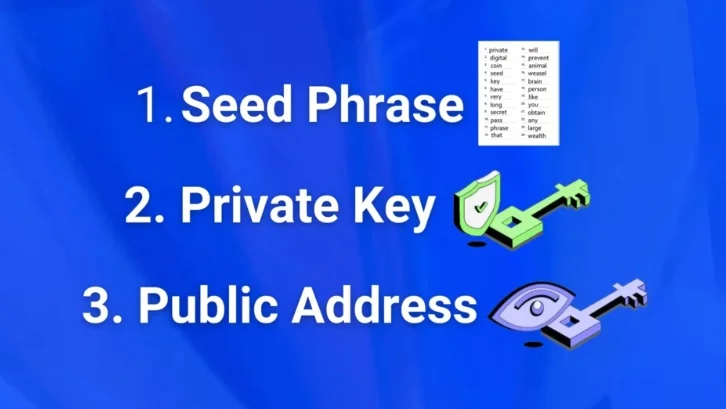
Why Does a Crypto Wallet Matter?
Crypto wallets are crucial because they give you true control and ownership over your digital money. Unlike keeping your funds on a crypto exchange, using a wallet means you, and only you, hold the keys to your assets.
When you use a crypto exchange,
crypto exchange: A company, similar to a stock exchange, that allows users to buy, sell, and trade cryptocurrencies, but they hold custody of your funds and private keys.
the exchange has control over your funds, not you. This can lead to problems like frozen accounts, where you can't access your money, or even loss of funds due to hacks targeting the exchange itself. Many users have faced difficulties with locked accounts and poor customer service on exchanges.
With your own crypto wallet, especially a cold wallet, you become your own bank. This means you have direct access to your digital money whenever you need it, without needing permission from a third party or worrying about an exchange getting hacked or locking your account.
Common Misconceptions
- Misconception: Crypto wallets actually store your digital money.
- Correction: Crypto wallets don't store crypto. Instead, they are tools that manage your access to your digital money, which actually lives on a public record called the blockchain.
- Misconception: If you lose your cold wallet, you lose all your crypto forever.
- Correction: Your digital money is not stored on the physical device. If you lose or break your cold wallet, you can recover your funds using your seed phrase on a new wallet, even a different brand.
- Misconception: Cold wallets charge you fees for using them.
- Correction: Cold wallets only have an initial purchase price. Any transaction fees you pay are either to the blockchain network for processing your transaction or to third-party services that partner with the wallet for features like buying or selling crypto.
- Misconception: Using a crypto wallet, especially a cold wallet, makes you immune to all scams.
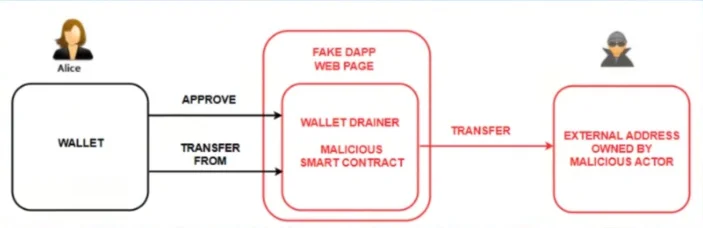
- Correction: While wallets are secure, most crypto scams, like social engineering and phishing, target users directly. Scammers manipulate you into giving up sensitive information, such as your seed phrase, meaning the user is the primary vulnerability.

Hot Wallets vs. Cold Wallets vs. Crypto Exchanges
There are different ways to manage your digital money, each with varying levels of security and control. The main types are hot wallets, cold wallets, and crypto exchanges.
A hot wallet is a software-based wallet always connected to the internet.
hot wallet: A software-based crypto wallet that is connected to the internet and used for active transactions, often as a desktop or mobile application.
Examples include mobile apps or programs on your computer. While convenient for frequent transactions, hot wallets are more vulnerable to online threats like malware because they are constantly connected to the internet. 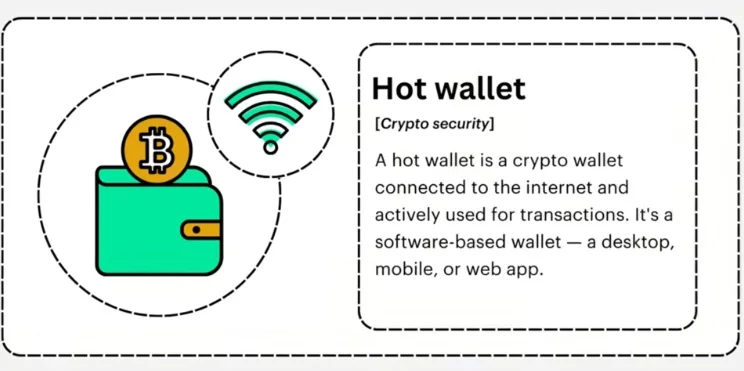
A cold wallet (also known as a hardware wallet) stores your private keys offline on a dedicated physical device.
cold wallet: A crypto wallet, typically a physical device, that stores private keys offline, protecting assets from online hacking and cyberattacks.
This offline storage makes them highly secure against online hacking and cyberattacks, acting like a vault for your digital money. Cold wallets are considered the most secure way to store cryptocurrency. 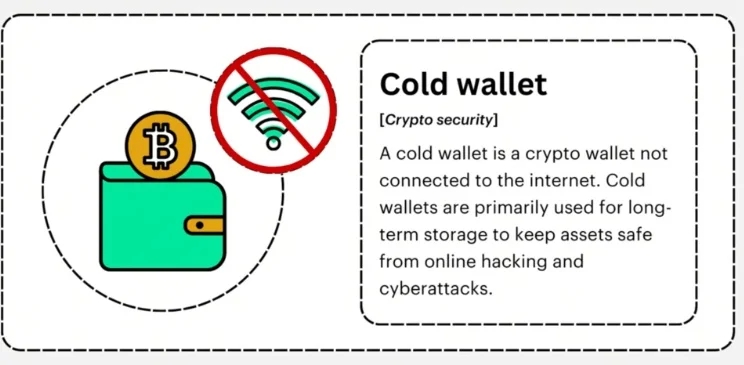
A crypto exchange, while used by many, is fundamentally different. When you keep your crypto on an exchange, they are custodial, meaning the exchange holds your private keys and thus controls your funds. This means you don't have full ownership and face risks if the exchange gets hacked or decides to freeze your account.
Hot Wallet | Cold Wallet | Crypto Exchange | |
|---|---|---|---|
Connection to Internet | Always online | Offline (connects briefly for transactions) | Always online (funds stored by exchange) |
Private Key Custody | You control (software-based) | You control (offline device) | Exchange controls (custodial) |
Security Level | Moderate (vulnerable to online attacks) | High (immune to online attacks, like a vault) | Lower (risk of exchange hacks, frozen accounts) |
Convenience | High (easy for frequent use) | Moderate (requires physical device) | High (easy to buy/sell/trade) |
Key Terms You Should Know
Term | Plain-English Meaning |
|---|---|
Blockchain | A public, distributed record that permanently records every single cryptocurrency transaction. |
Cold Wallet | A crypto wallet, typically a physical device, that stores private keys offline, protecting assets from online hacking and cyberattacks. |
Crypto Exchange | A company, similar to a stock exchange, that allows users to buy, sell, and trade cryptocurrencies, but they hold custody of your funds and private keys. |
Crypto Wallet | A tool used to securely manage digital money, allowing users to send, receive, store, and track their crypto assets in one place. |
Hot Wallet | A software-based crypto wallet that is connected to the internet and used for active transactions, often as a desktop or mobile application. |
Phishing | A scam that tricks users into interacting with a fake website or platform to steal sensitive information or gain access to their wallet. |
Private Key | A secret code that acts as the true master key to your crypto wallet, allowing you to access and manage your digital funds. |
Public Address | A shareable address, similar to an email address, used only to receive or send cryptocurrency. |
Seed Phrase | A set of 12 or 24 words that acts as a master password or backup for your crypto wallet, allowing you to recover access. |
Social Engineering | A scam that manipulates users, often by impersonation or creating urgency, to give up private information like a seed phrase. |
Frequently Asked Questions
Is a crypto wallet safe?
A crypto wallet, especially a cold wallet, is a very secure way to manage your digital money because you control your private keys. However, safety also depends on your actions; you must protect your seed phrase and be cautious of scams like social engineering and phishing.
Do I need a crypto wallet to use crypto?
Yes, if you want true security and control over your digital money, you need a crypto wallet. While you can keep crypto on a crypto exchange, the exchange controls your funds, which carries risks. A wallet ensures only you can access your assets.
How is a crypto wallet different from a crypto exchange?
A crypto wallet gives you direct control over your digital money by managing your private keys. A crypto exchange acts as an intermediary, holding your funds for you. With an exchange, you don't own the private keys, meaning the exchange has ultimate control over your assets.
Can anyone use a crypto wallet?
Yes, anyone can use a crypto wallet. They are designed to help individuals securely manage their digital money, allowing them to send, receive, and track their cryptocurrency directly.
What if I lose my cold wallet or it breaks?
If you lose or break your cold wallet, you do not lose your digital money. Your crypto is stored on the blockchain, not the device itself. You can easily recover all your funds by using your seed phrase to set up a new wallet, even if it's a different brand. They don't charge any fees either, beyond the initial purchase cost of the device.
Do I pay fees to use a cold wallet?
No, you only pay an initial purchase price for the cold wallet device itself. Any fees you encounter during transactions are typically blockchain network fees for processing the transaction or fees charged by third-party services integrated with your wallet for specific actions like buying or selling crypto.